RV solar kits vs portable panels
Peak sun hours, a derate factor and battery watt-hours decide whether you mount panels to the roof or chase the sun with one.
Updated 2026-09-17
We may earn a commission if you buy through links on this page. It never changes what you pay. How we make money
A roof array and a folding panel solve different problems, and the difference shows up in two numbers: how many watt-hours you use in a day, and whether you park in the sun or in the shade. This guide is for a trailer, van or truck camper running 12 V loads off a battery, where the choice is a permanent 400 W kit, a 100 W panel you set out at each stop, or both. Storage sits in the middle of that decision, so two batteries are compared here too.
How to decide
Solar output is not a watt rating, it is watts times peak sun hours times a derate factor. Peak sun hours are the number of hours per day that add up to full-intensity sun: roughly 4 across much of the country in spring and fall, 5 to 6 in the desert southwest in summer, and 3 or fewer up north in winter. Derate by about 25 percent for heat, wiring, soiling and imperfect angle. So:
- The 400 W kit returns 400 x 4 x 0.75 = 1,200 Wh on a fair day, and 400 x 3 x 0.75 = 900 Wh in weak winter light.
- One 100 W folding panel returns 100 x 4 x 0.75 = 300 Wh on the same day.
Now put a load against it. The 800 Wh per day list from our power station guide, a duty-cycled 12 V fridge plus a CPAP, lights and phones, needs 800 divided by 0.75, divided by 4 peak sun hours, which is 267 W of panel to break even. The 400 W kit clears that with enough margin to still finish the day even under cloud. Three 100 W portables, at 300 W, only just do it on a perfect day.
Storage converts amp-hours to watt-hours by multiplying by voltage: 100 Ah at 12.8 V nominal is 1,280 Wh, and 200 Ah is 2,560 Wh. Against an 800 Wh day, the 100 Ah battery is 1.6 days of autonomy and the 200 Ah is 3.2 days. Two days of buffer is the usual target for a rig without a generator, which means 1,600 Wh, which means the 200 Ah.
Size the charge controller from array watts divided by battery voltage. The kit's 400 W divided by 12.8 V is about 31 A, so its included 40 A MPPT controller has roughly a quarter of its rating in reserve. The folding panel ships with a 10 A PWM controller instead, which suits one 100 W panel at about 7.8 A but cannot be grown: four panels would ask 31 A from a 10 A part.
The last number is the one that decides the roof-versus-portable argument, and it is trigonometry. A flat-mounted panel collects the direct beam in proportion to the sine of the sun's elevation, so when the sun sits 30 degrees above the horizon, a flat panel takes in about 50 percent of what an aimed panel gets. Morning, evening, winter and any northern latitude all push in that direction, and so does parking under a tree for shade. That is the case for a portable you can put 20 feet away in the sun while the rig stays cool, and the reason many people end up owning both.
Compared
| Pick | Role | Rated output or capacity | Weight | Price |
|---|---|---|---|---|
| ECO-WORTHY 400W 12V MPPT Kit | Roof-mounted array plus a 40A MPPT controller | 400 W array, 4 x 100 W rigid panels | 58.2 lbs, panels only | $419.99 |
| ECO-WORTHY 100W Portable Panel | Folding panel you set out and aim | 100 W through a 10A PWM controller | 11 lbs | $89.99 |
| Power Queen 12V 100Ah | Storage, Group 31 case | 1,280 Wh (100 Ah at 12.8 V) | 24.25 lbs | $251.99 |
| Power Queen 12V 200Ah | Storage, double runtime | 2,560 Wh (200 Ah at 12.8 V) | 48.28 lbs | $389.99 |
Two notes on that table. Neither panel product has an AC output to compare, because panels and controllers make DC only; the kit's 1100 W or 2000 W inverter is a paid add-on, and the folding panel has none at all. The batteries likewise have no inverter built in, just a 100 A BMS, which at 12.8 V is about 1,280 W of DC draw.
The picks
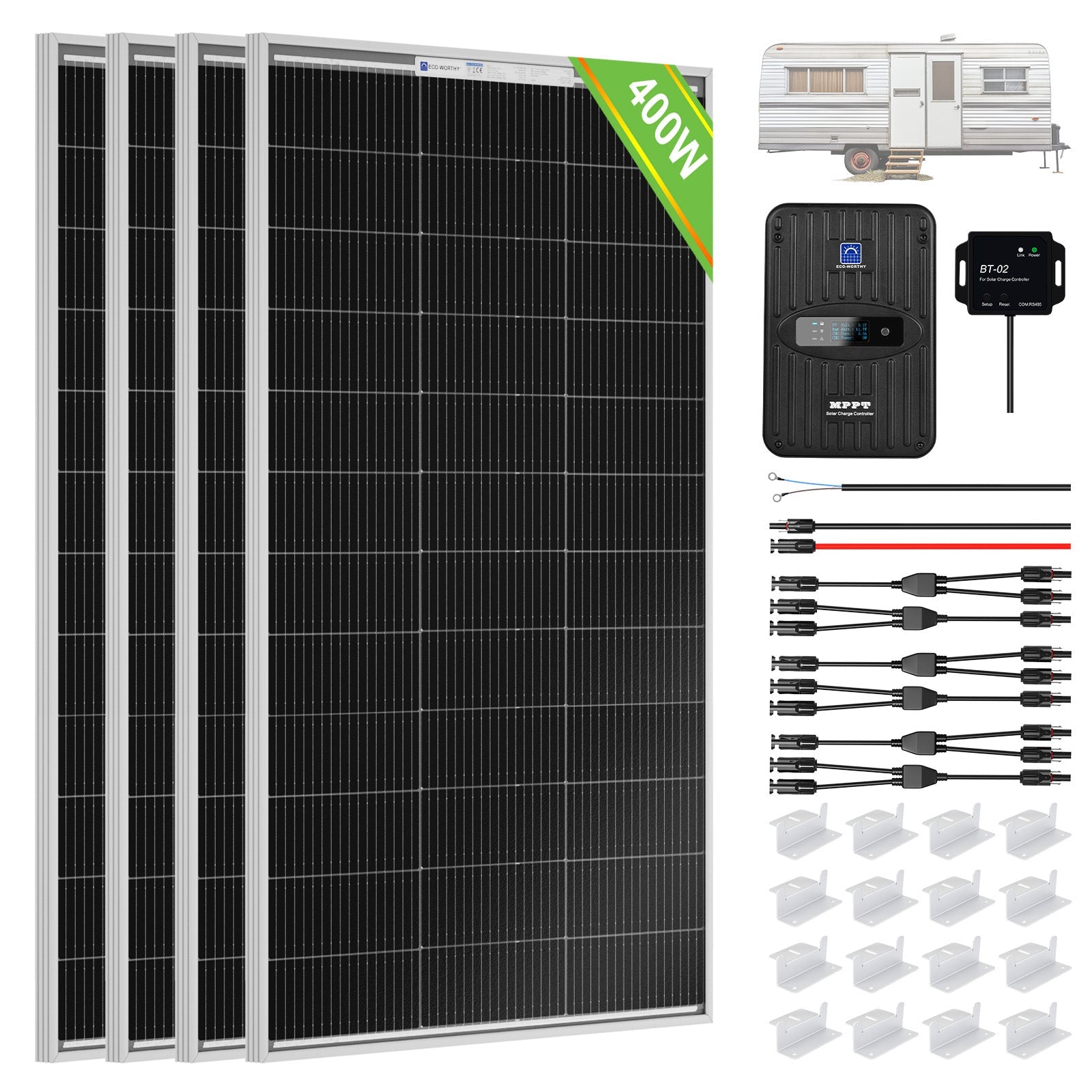
ECO-WORTHY 400W 12V (4x100W) Complete MPPT Off Grid Solar Kit
Mounts flat on an RV roof for permanent solar charging rather than a panel you set up and pack away each stop.
- Capacity:
- 400W array (4 x 100W rigid monocrystalline panels)
- AC output:
- N/A: panels plus a 40A MPPT controller only in the base kit; a 1100W or 2000W inverter is a paid add-on
- Weight:
- 58.2 lbs panels only (4 x 14.55 lbs per ECOM100W panel, per datasheet)
- Wall recharge:
- N/A: charges via sunlight through the 40A MPPT controller, not wall power
About $419.99 (checked 2026-09-17)
Check price at Eco-WorthyThis is the buy for a rig that lives off-grid for days at a time and parks wherever it lands, since 400 W on the roof harvests about 1,200 Wh on a fair day without anyone setting anything up. Four rigid panels at 14.55 pounds each is 58.2 pounds of roof load and four sets of brackets and sealed penetrations, so budget a day for installation. What it gives up is aiming and shade tolerance: flat panels lose roughly half their output when the sun is 30 degrees up, and one tree ruins the afternoon. The 40 A MPPT controller included is sized with headroom over the array's 31 A.

ECO-WORTHY 100W Portable Solar Panel for Outdoor Camping RV
Packs down small enough to store in a trunk or RV bay between trips rather than staying mounted.
- Capacity:
- 100W folding monocrystalline panel
- AC output:
- N/A: DC solar output through a 10A PWM controller, no inverter
- Weight:
- 11 lbs (5 kg)
- Wall recharge:
- N/A: charges via sunlight; folds from 106.4x66.6cm to 53.2x66.6x2.5cm for transport
About $89.99 (checked 2026-09-17)
Check price at Eco-WorthyAt $89.99 and 11 pounds, this is the panel to buy first if you are not sure you need solar at all. It folds from 106.4 by 66.6 cm down to 53.2 by 66.6 by 2.5 cm, so it slides into an RV bay or a trunk between trips and drills no holes in anything. What it gives up is scale and expansion: 300 Wh on a good day covers lights, phones and a fan but not a fridge, and the bundled 10 A PWM controller caps how many panels can share it. It also has to be carried out, aimed and brought back in at every stop.

Power Queen 12V 100Ah Group 31 Deep Cycle Lithium LiFePO4 Battery
Drops into an existing Group 31 battery box on a trailer or boat without a size mismatch.
- Capacity:
- 100Ah / 1280Wh (12.8V nominal)
- AC output:
- N/A: raw DC battery with a 100A BMS (~1,280W equivalent at 12.8V), no built-in inverter
- Weight:
- 24.25 lbs
- Wall recharge:
- 14.6V/20A charger, about 5 hours 0-100%
About $251.99 (checked 2026-09-17)
Check price at Power QueenStorage is what solar fills, and 1,280 Wh is the sensible starting point for weekend trips on an 800 Wh day. The Group 31 case is the practical detail: it drops into an existing battery box on a trailer or boat without a tray modification, at 24.25 pounds instead of the lead-acid weight you removed. What it gives up is depth of buffer, at about a day and a half of autonomy, so a cloudy stretch means driving or a shore charge. Its 20 A charger refills the whole battery in about 5 hours.

Power Queen 12V 200Ah Deep Cycle LiFePO4 Lithium Battery
Doubles the runtime of the 100Ah battery for a build that needs a full day off-grid without a generator.
- Capacity:
- 200Ah / 2560Wh (12.8V nominal)
- AC output:
- N/A: raw DC battery with a 100A BMS (~1,280W equivalent at 12.8V), no built-in inverter
- Weight:
- 48.28 lbs
- Wall recharge:
- 14.6V/40A charger available, about 5 hours 0-100%
About $389.99 (checked 2026-09-17)
Check price at Power QueenDouble the storage is the right answer when the load list includes a fridge and you want two full days of margin, since 2,560 Wh against an 800 Wh day is a bit over three days. Paired with the 400 W roof kit at 1,200 Wh a day, this is the combination that stops you thinking about power at all in fair weather. What it gives up is 48.28 pounds and floor space, plus a bigger charger to refill it in the same 5 hours, at 40 A instead of 20 A. Both batteries share a 100 A BMS, so the 200 Ah does not raise the ceiling on how much you can pull at once, only how long you can pull it.
What we'd skip
We would skip flooded lead-acid "deep cycle" batteries for this job, whatever the sticker price. You only use about half of a lead-acid battery's rated capacity before damaging it, so a nominal 1,280 Wh battery really gives you around 640 Wh, at roughly double the weight per usable watt-hour, and it wants venting and topping up. Charging is slower too, which matters when your window is 4 peak sun hours.
FAQ
how many solar panels to charge a 100ah battery
Refilling 1,280 Wh in a single day needs 1,280 divided by 0.75, divided by 4 peak sun hours, which is about 427 W of panel. One 100 W panel returns roughly 300 Wh a day, so it would take four days to fill an empty battery. In practice you size panels against daily use, not against battery size.
can you use a portable solar panel with an rv roof kit
Yes, and it is a common setup, but not on the same controller. The folding panel's bundled 10 A PWM controller has no room for the roof array's 31 A, so the portable either runs its own controller into the same battery or plugs into the kit's 40 A MPPT input if the voltage window allows. Wiring both through one undersized controller is the mistake to avoid.
do you need an inverter for an rv solar kit
Only for 120 V loads. The base kit is panels plus a 40 A MPPT controller, and Eco-Worthy sells the 1100 W and 2000 W inverters separately, so a DC-only rig with 12 V lights, a 12 V fridge and USB charging never needs one. Add an inverter when something has a wall plug and no DC option.
Specs and prices come from each retailer's product page on the date shown on the card. This is a research-based comparison, not a hands-on test.
Products in this guide
- ECO-WORTHY 400W 12V (4x100W) Complete MPPT Off Grid Solar Kit — Eco-Worthy
- ECO-WORTHY 100W Portable Solar Panel for Outdoor Camping RV — Eco-Worthy
- Power Queen 12V 100Ah Group 31 Deep Cycle Lithium LiFePO4 Battery — Power Queen
- Power Queen 12V 200Ah Deep Cycle LiFePO4 Lithium Battery — Power Queen